Creativity in hypospadias surgery
What is Hypospadias? How is Hypospadias Surgery Performed?
Hypospadias is a common congenital anomaly involving the penis and the urethra. At birth, the urethral opening (meatus) is not located at the tip of the glans penis; instead, it opens along the underside (ventral aspect) of the shaft or, in more severe forms, between the scrotal folds.
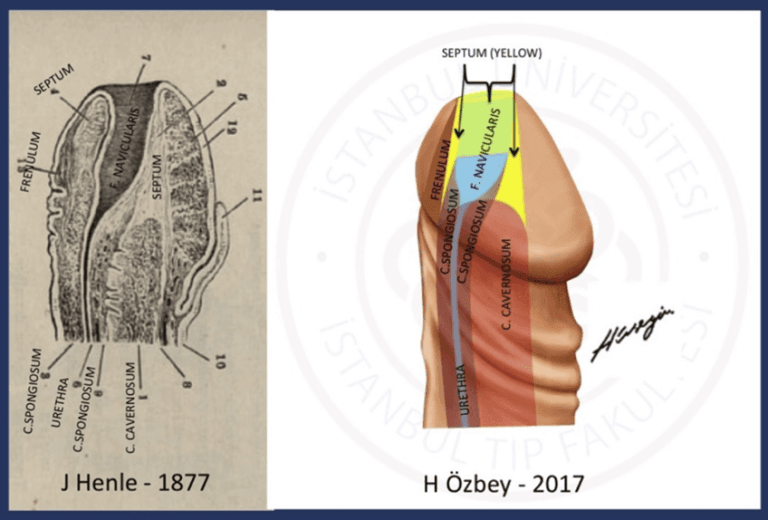
Because the foreskin (prepuce) typically fails to close on the underside while remaining hooded on top, parents often describe the baby as “born half-circumcised.” In addition, ventral curvature (chordee) may cause the penis to bend downward. The condition also involves a deficiency in the supportive anatomical structures of the anterior urethra, including the corpus spongiosum, septum glandis, fossa navicularis, and frenulum.
Hypospadias repair should aim for an uncomplicated, single-stage anatomical reconstruction that strictly respects the functional anatomy of the penis and urethra.
It occurs in about 1 in 200 boys.
The baby, often described by parents as ‘half-circumcised’ due to the incomplete foreskin.
The treatment is surgical. The goal is a single-stage, anatomical reconstruction.
The Glanular-Frenular Collar (GFC) Technique and The Septum Glandis
Due to centuries-old misconceptions regarding the reconstruction of the male urethra, hypospadias repair has long been considered a complex surgical procedure where achieving satisfactory outcomes remains challenging—even in experienced hands.
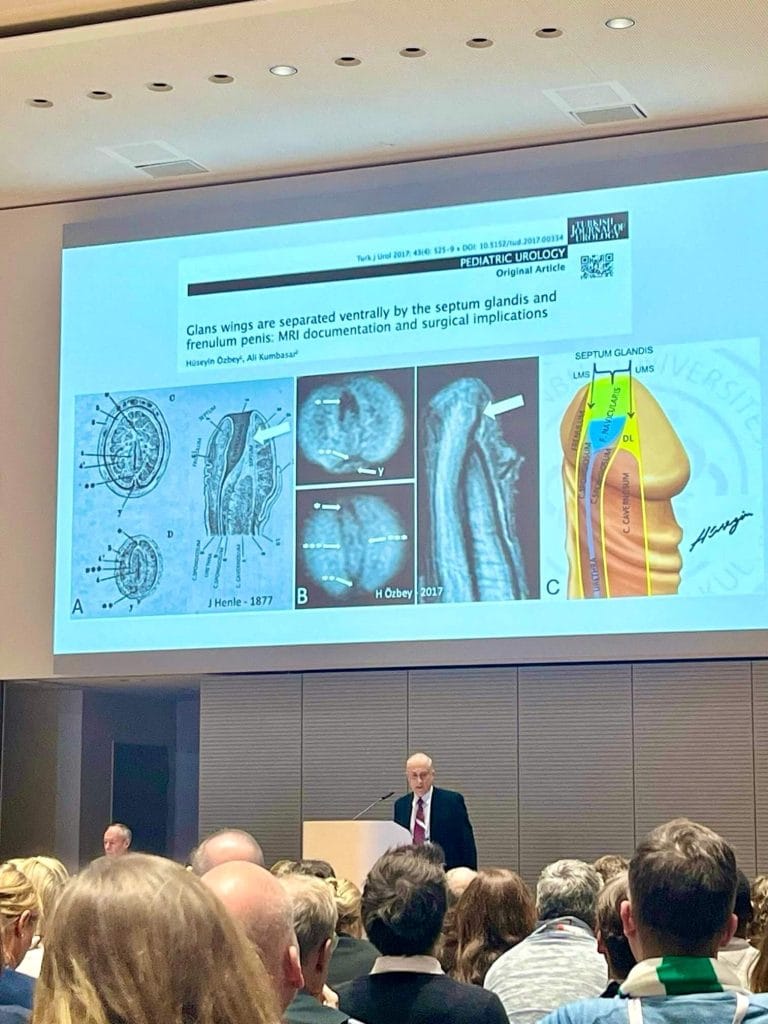
A deeper understanding of the anatomical differences between the glanular and penile urethra, along with the identification of structures such as the septum glandis and the fossa navicularis, has sparked a paradigm shift in hypospadias surgery. The insight that the glanular wings are not ventrally fused, but naturally separated by the septum glandis, elucidates the root causes of common complications such as meatal stenosis, urethrocutaneous fistula, and glans dehiscence.
The GFC technique reconstructs this historically overlooked septum glandis and re-establishes the frenulum, thereby forming the ventral wall of the glanular urethra without dissecting the glans tissue, while fully preserving the natural space of the navicular fossa. By mimicking the true embryological development of the glanular urethra, the GFC approach restores the native functional anatomy of the glans penis.
Consequently, the GFC technique significantly minimizes the risk of complications and ensures a natural, steady, and wave-like urinary stream in every patient.
Why Choose the GFC Technique?
This technique preserves the integrity of the glans by avoiding traditional extensive dissection and glans fusion—the primary cause of major postoperative complications in hypospadias surgery.
Lower Complication Rates
Eliminating surgical trauma to the glans tissue drastically reduces the risk of meatal stenosis, urethrocutaneous fistula, and wound breakdown.
Anatomical reconstruction
Restores the naturally missing structures—including the septum glandis, fossa navicularis, and frenulum—in full alignment with normal embryological anatomy.
Physiological Urinary Stream
Re-establishes a straight and wave-like urinary stream without spraying or deflection.

Who Is Prof. Dr. Hüseyin Özbey?
Prof. Dr. Hüseyin Özbey earned his medical degree from the Istanbul Faculty of Medicine, Istanbul University, where he also pursued his academic career, accumulating more than 30 years of clinical and academic experience in pediatric surgery and pediatric urology.
Between 1997 and 1998, and again from 2001 to 2002, he collaborated with Prof. Michael Höllwarth at the Medical University of Graz in Austria. From 2017 to 2020, he served as the Head of the Division of Pediatric Urology at the Istanbul Faculty of Medicine, while also contributing as a visiting faculty member in Graz (Austria) and Moscow (Russia). He currently sees patients at his private practice in Istanbul.
Pioneering Hypospadias Surgery:
Prof. Özbey is the first surgeon to describe the septum glandis and define the true functional anatomy of the glanular urethra—critical structures historically overlooked in hypospadias repair. Building on these fundamental anatomical discoveries, he developed the GFC (Glanular-Frenular Collar) technique, a groundbreaking approach that achieves complete anatomical reconstruction while fully preserving the integrity of the glans.
For over 15 years, he has regularly presented his meticulously tracked patient cohorts and documented high clinical success rates at leading international congresses in pediatric surgery and pediatric urology.
He was honored with this prestigious title in recognition of his outstanding surgical contributions at the Department of Pediatric and Adolescent Surgery, Medical University of Graz, Austria.
He developed this groundbreaking surgical method—which fully preserves natural penile anatomy without incising or dissecting the glans tissue—and introduced it into international medical literature and routine clinical practice.
Get in Touch
Pediatric surgical and urological procedures are sensitive and emotional journeys for families. We approach every diagnosis and treatment plan with the highest standard of specialized clinical care and diligence.
Explore our resources to better understand your child’s health and treatment options, or contact us directly to ask a question and request an appointment.
Scientific Publications
Discover the peer-reviewed research papers, clinical studies, and scientific publications by Prof. Dr. Hüseyin Özbey that have appeared in leading journals of pediatric surgery and pediatric urology.
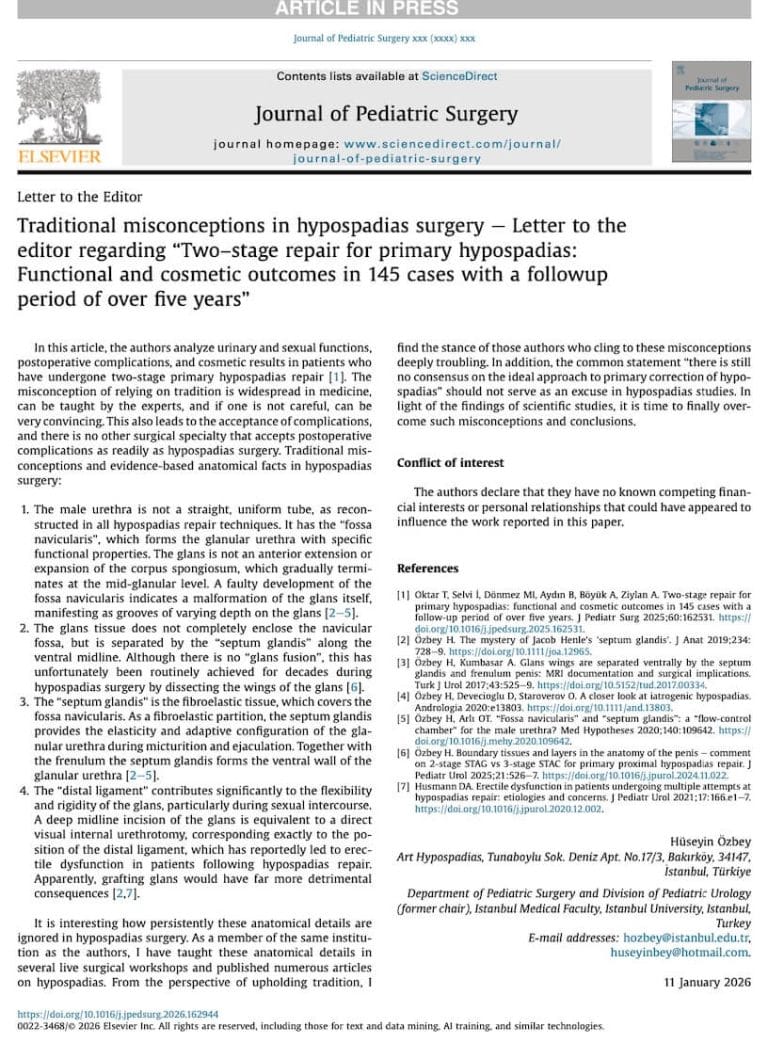
In my latest article, I summarize why the “Tubularized Incised Plate / TIPU / Snodgrass” technique — which has unfortunately been widely used worldwide and in our country for about 30 years — is wrong and leads to complications.
Özbey H. Traditional misconceptions in hypospadias surgery. J Pediatr Surg 2026. doi:10.1016/j.jpedsurg.2026.162944

Meetings & Congresses
Through live surgery workshops and international lectures, Prof. Dr. Hüseyin Özbey shares his expertise in the GFC technique with colleagues worldwide, promoting global standards for precise anatomical hypospadias repair.